http://www.nasa.gov/feature/ames/sofia/flying-observatory-detects-atomic-oxygen-in-martian-atmosphere
Tech Image of the Day
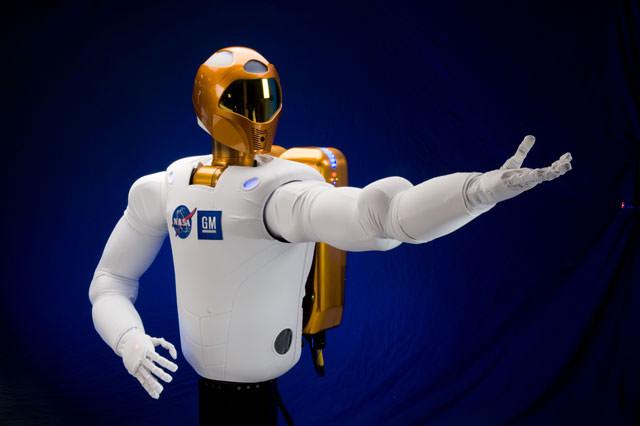
ROBONAUT 2
Monday, May 9, 2016

Monday, August 20, 2012
CURIOSITY: Target Site for First Drive fixed- GLENELG
The scientists and engineers of NASA's Curiosity rover mission have selected the first driving destination for their one-ton, six-wheeled mobile Mars laboratory. The target area, named Glenelg, is a natural intersection of three kinds of terrain. The trek to Glenelg will send the rover 1,300 feet (400 meters) east-southeast of its landing site. One of the three types of terrain intersecting at Glenelg is layered bedrock, which is attractive as the first drilling target.

Prior to the rover's trip to Glenelg, the team in charge of Curiosity's Chemistry and Camera instrument, or ChemCam, is planning to give their mast-mounted, rock-zapping laser and telescope combination a thorough checkout. On Saturday night, Aug. 18, ChemCam is expected to "zap" its first rock in the name of planetary science. It will be the first time such a powerful laser has been used on the surface of another world. Rock N165 looks like a typical Mars rock, about three inches wide which is about 10 feet away is going to be hit with 14 millijoules of energy 30 times in 10 seconds.


Mission engineers are devoting more time to planning the first roll of Curiosity. In the coming days, the rover will exercise each of its four steerable (front and back) wheels, turning each of them side-to-side before ending up with each wheel pointing straight ahead. On a later day, the rover will drive forward about one rover-length (10 feet, or 3 meters), turn 90 degrees, and then kick into reverse for about 7 feet (2 meters).

Friday, August 17, 2012
Curiosity- checking continues, and more images
Mission controllers at NASA's Jet Propulsion Laboratory in Pasadena,
Calif., are checking out Curiosity's subsystems and 10 instruments.
Curiosity is in the opening days of a two-year mission to investigate
whether the conditions at Mars have been favorable for microbial life and preserving
clues in the rocks about possible past life.
During this time more colour images have been beamed to Earth from mast cam of Curiosity.
This color image from NASA's Curiosity rover shows part of the wall of Gale Crater, the location on Mars where the rover landed on Aug. 5, 2012 PDT (Aug. 6, 2012 EDT). This is part of a larger, high-resolution color mosaic made from images obtained by Curiosity's Mast Camera.

This image from NASA's Curiosity rover looks south of the rover's landing site on Mars towards Mount Sharp. This is part of a larger,high-resolution color mosaic made from images obtained by Curiosity's Mast Camera. In this version of the image, colors have been modified as if the scene were transported to Earth and illuminated by terrestrial sunlight. This processing, called "white balancing," is useful for scientists to be able to recognize and distinguish rocks by color in more familiar lighting.

This color image from NASA's Curiosity rover shows an area excavated by the blast of the Mars Science Laboratory's descent stage rocket engines. This is part of a larger, high-resolution color mosaic made from images obtained by Curiosity's Mast Camera.

This mosaic image shows part of the left side of NASA's Curiosity rover and two blast marks from the descent stage's rocket engines. The images that were used to make the mosaic were obtained by the rover's Navigation cameras on Aug. 7 PDT (Aug. 8 EDT).

During this time more colour images have been beamed to Earth from mast cam of Curiosity.
This color image from NASA's Curiosity rover shows part of the wall of Gale Crater, the location on Mars where the rover landed on Aug. 5, 2012 PDT (Aug. 6, 2012 EDT). This is part of a larger, high-resolution color mosaic made from images obtained by Curiosity's Mast Camera.

This image from NASA's Curiosity rover looks south of the rover's landing site on Mars towards Mount Sharp. This is part of a larger,high-resolution color mosaic made from images obtained by Curiosity's Mast Camera. In this version of the image, colors have been modified as if the scene were transported to Earth and illuminated by terrestrial sunlight. This processing, called "white balancing," is useful for scientists to be able to recognize and distinguish rocks by color in more familiar lighting.

This color image from NASA's Curiosity rover shows an area excavated by the blast of the Mars Science Laboratory's descent stage rocket engines. This is part of a larger, high-resolution color mosaic made from images obtained by Curiosity's Mast Camera.

This mosaic image shows part of the left side of NASA's Curiosity rover and two blast marks from the descent stage's rocket engines. The images that were used to make the mosaic were obtained by the rover's Navigation cameras on Aug. 7 PDT (Aug. 8 EDT).

Thursday, August 9, 2012
Curiosity: Rocket Thrusters Expose Bedrock


Wednesday, August 8, 2012
Curiosity: Beams back new colour images and Health check continues.
Curiosity is healthy as it continues to familiarize itself with its new home in Gale Crater and check out its systems. The team's plans for Curiosity checkout today included raising the rover's mast and continued testing of its high-gain antenna, whose pointing toward Earth will be adjusted on Sol 2. Science data were collected from Curiosity's Radiation Assessment Detector, and activities were performed with the Rover Environmental Monitoring Station instrument. Curiosity transmitted its first color image from the surface of Mars, from the Mars Hand Lens Imager, or MAHLI, showing part of the north rim of Gale Crater. Additional calibration images were received from Curiosity's Navcam and Mastcam. All systems are go for deployment of the rover's remote sensing mast on Sol 2, followed by a 360-degree pan by the rover's Navcam.
The four main pieces of hardware
that arrived on Mars with NASA's Curiosity rover were spotted by NASA's Mars
Reconnaissance Orbiter (MRO). The High-Resolution Imaging Science Experiment
(HiRISE) camera captured this image about 24 hours after landing.

The Curiosity rover is in the center of the image. To the
right, approximately 4,900 feet (1,500 meters) away, lies the heat shield,
which protected the rover from 3,800-degree-Fahrenheit (about 2,100 degrees
Celsius) temperatures encountered during its fiery descent. On the lower left,
about 2,020 feet (615 meters) away, are the parachute and back shell. The
parachute has a constructed diameter of 71 feet (almost 21.5 meters) and an
inflated diameter of 51 feet (nearly 16 meters). The back shell remains
connected to the chute via 80 suspension lines that are 165 feet (50 meters)
long. To the upper-left, approximately 2,100 feet (650 meters) away from the
rover, is a discoloration of the Mars surface consistent with what would have
resulted when the rocket-powered Sky Crane impacted the surface.

This image comparison shows a view through a Hazard-Avoidance camera on
NASA's Curiosity rover before and after the clear dust cover was
removed. Both images were taken by a camera at the front of the rover.
Mount Sharp, the mission's ultimate destination, looms ahead.

This picture of the Martian landing site of NASA's Curiosity rover puts a
color view obtained by the rover in the context of a computer
simulation derived from images acquired from orbiting spacecraft. The
view looks north, showing a distant ridge that is the north wall and rim
of Gale Crater.
The color image was obtained by Curiosity's Mars Hand Lens Imager (MAHLI) on Aug. 6 PDT (Aug. 7 UTC), the first Martian day after Curiosity's landing on Aug. 5 PDT (Aug. 6 UTC). It has been rendered about 10 percent transparent so that scientists can see how it matches the simulated terrain in the background. The MAHLI image was taken while the camera's transparent dust cover was still on. Curiosity's descent coated the cover with a thin film of dust.
The peak seen on the left-side of the MAHLI image is about 15 miles (24 kilometers) distant with a height of about 3,775 feet (1,150 meters) high. The box with arrows at the upper left indicates direction. The arrow pointing up is "up" with respect to the gravity of Mars. The arrow pointing to the right is east. North would be an arrow pointing into the image (that is, the MAHLI view is toward the north).
The MAHLI is located on the turret at the end of Curiosity's robotic arm. At the time the MAHLI image was acquired, the robotic arm was in its stowed position. It has been stowed since the rover was packaged for its Nov. 26, 2011, launch.
The color image was obtained by Curiosity's Mars Hand Lens Imager (MAHLI) on Aug. 6 PDT (Aug. 7 UTC), the first Martian day after Curiosity's landing on Aug. 5 PDT (Aug. 6 UTC). It has been rendered about 10 percent transparent so that scientists can see how it matches the simulated terrain in the background. The MAHLI image was taken while the camera's transparent dust cover was still on. Curiosity's descent coated the cover with a thin film of dust.
The peak seen on the left-side of the MAHLI image is about 15 miles (24 kilometers) distant with a height of about 3,775 feet (1,150 meters) high. The box with arrows at the upper left indicates direction. The arrow pointing up is "up" with respect to the gravity of Mars. The arrow pointing to the right is east. North would be an arrow pointing into the image (that is, the MAHLI view is toward the north).
The MAHLI is located on the turret at the end of Curiosity's robotic arm. At the time the MAHLI image was acquired, the robotic arm was in its stowed position. It has been stowed since the rover was packaged for its Nov. 26, 2011, launch.

This image is a 3-D view behind NASA's Curiosity rover, which landed on
Mars on Aug. 5 PDT (Aug. 6 EDT). The anaglyph was made from a stereo
pair of Hazard-Avoidance Cameras on the rear of the rover. It has been
cropped. Part of the rim of Gale Crater, which is a feature the
size of Connecticut and Rhode Island combined, stretches from the top
middle to the top right of the image. One of the rover's wheels can be
seen at bottom right. The bright spot is saturation from the sun.

This image is a 3-D view in front of NASA's Curiosity rover, which
landed on Mars on Aug. 5 PDT (Aug. 6 EDT). The anaglyph was made from a
stereo pair of Hazard-Avoidance Cameras on the front of the rover. The
image is cropped but part of Mount Sharp, a peak that is about 3.4 miles
(5.5 kilometers) high, is still visible rising above the terrain. This image was captured by the rover's front left Hazard-Avoidance
camera at full resolution shortly after it landed.
Tuesday, August 7, 2012
Curiosity caught on landing.
An image from the High Resolution Imaging Science Experiment (HiRISE)
camera aboard NASA's Mars Reconnaissance Orbiter (MRO) captured the
Curiosity rover still connected to its 51-foot (almost 16 meter)-wide
parachute as it descended toward its landing site at Gale Crater.
via NASA Jet Propulsion Laboratory (JPL)

via NASA Jet Propulsion Laboratory (JPL)

Subscribe to:
Posts (Atom)